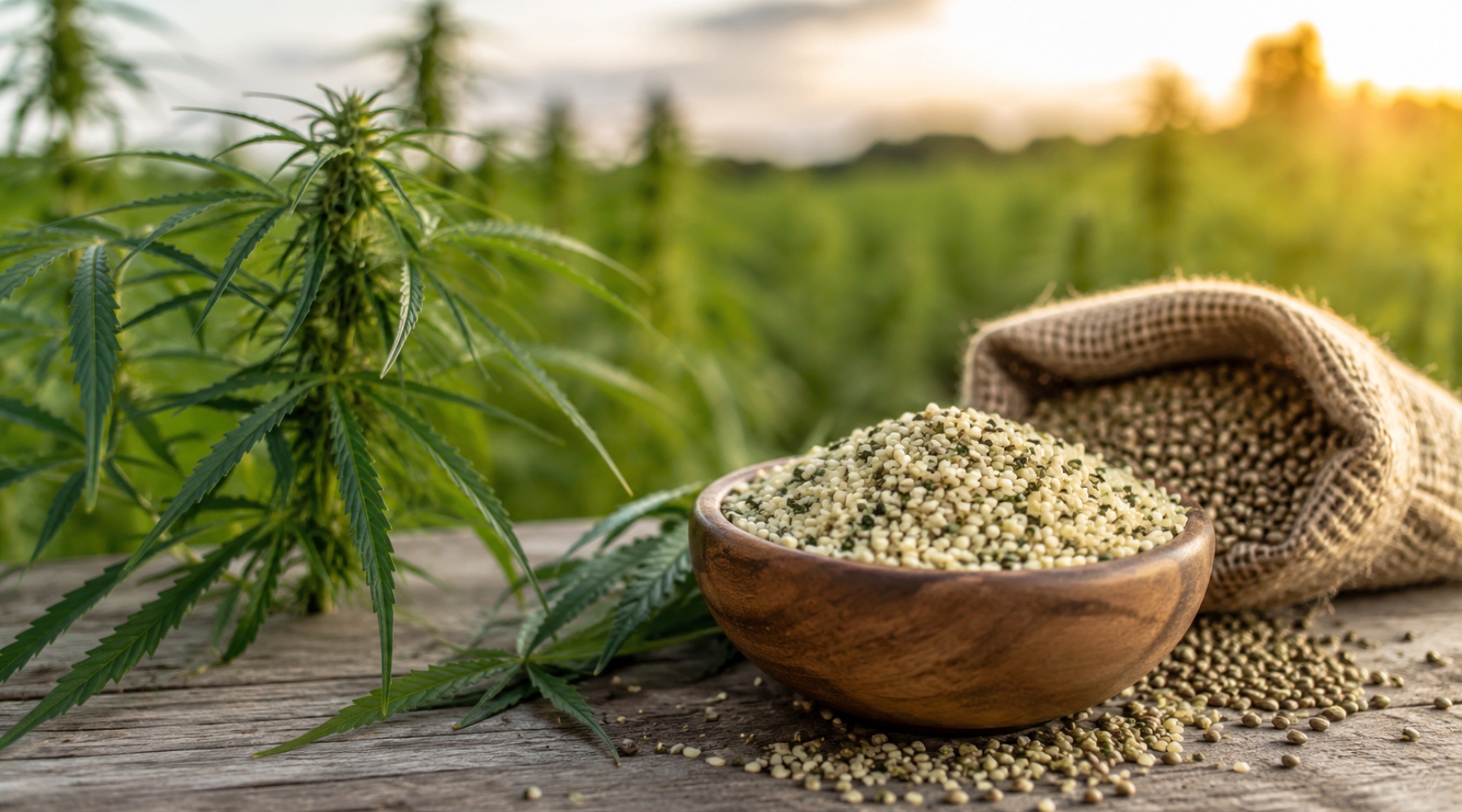
Hemp is one of the oldest crops ever grown on Irish soil. It made rope, cloth, and linen. It fed the textile trade during the 1800s. And then, somewhere in the twentieth century, it got a bad reputation it never deserved, and quietly disappeared from Irish fields for decades.
Now it’s back. And this time, it’s not going into rope. It’s going into your breakfast.
At Fox Covert Farm in Kilcormac, Co. Offaly, we grow hemp seeds under licence from the Department of Health. We harvest them, shell them, mill them, and sell them directly to Irish households who want a natural, traceable, plant-based food they can actually trust. No mystery ingredients. No supply chain on the other side of the world. Just hemp, grown here, on Irish ground.
If you’ve been curious about hemp in Ireland, what it actually is, whether it’s legal, and what you’re supposed to do with it, this guide is for you.
Hemp is a variety of the Cannabis sativa plant. That sentence stops some people in their tracks, so let’s deal with it straight away.
Hemp and recreational cannabis do come from the same plant species. But they are not the same crop, and they do not behave the same way. The critical difference is THC, tetrahydrocannabinol, the compound responsible for the psychoactive effect associated with cannabis. Industrial hemp contains only trace amounts of THC, well below 0.2% under EU regulations. At that level, hemp has no psychoactive effect whatsoever. You cannot get high from eating hemp seeds. Not in any quantity.
What hemp does contain is an impressive nutritional profile: complete plant protein with all nine essential amino acids, omega-3 and omega-6 fatty acids in an almost ideal ratio, magnesium, iron, zinc, copper, and fibre. It is a food crop in the truest sense, and it has been used as one for thousands of years across Asia, Europe, and the Americas.
Industrial hemp is also fast-growing, low-input, and naturally resistant to most pests. It improves soil structure, suppresses weeds through its dense canopy, and can be harvested with conventional farm equipment. From an agricultural standpoint, it is a genuinely useful rotation crop. From a food standpoint, it is seriously underrated.
Yes, completely and unambiguously, when it comes to food.
Hemp seeds and hemp seed-derived products, including hemp hearts (shelled hemp seeds) and milled hemp, do not fall within the scope of the Misuse of Drugs Act in Ireland. They are also not subject to the EU Novel Food Regulation. You can buy them, eat them, cook with them, and add them to your child’s porridge without any legal concern whatsoever.
The regulation around hemp in Ireland gets complicated when you move into CBD oils and cannabinoids, which involve different parts of the plant and a separate regulatory framework. But for hemp seeds and the foods made from them, the legal position is clear and has been for years.
Farmers who grow hemp in Ireland do require an annual licence from the Health Products Regulatory Authority (HPRA). At Fox Covert Farm, we operate under that licence every growing season. The crop must use approved varieties with THC content below 0.2%, and the growing location must be registered. This level of oversight is precisely what makes Irish-grown hemp food so traceable and trustworthy, the regulatory process, while rigorous, is also the paper trail that guarantees what you’re eating is exactly what it says on the packet.
Hemp’s history in Ireland is much longer than most people realise. Historical references to hemp cultivation on the island appear as far back as the late twelfth century. During periods of British rule, hemp cultivation was actively encouraged across the island, it was woven into the linen and textile trades that shaped entire counties.
Hemp was used to make rope, sailcloth, and sacking. During the Second World War, shortages of imported hemp created real pressure on Irish industry. In the 1960s, it was discussed as a possible source of paper pulp. In the 1990s, it was considered for MDF production.
And then the modern food conversation started. When you look at hemp seeds, not hemp fibre, not cannabinoids, but the seed itself, you find a food with a nutritional profile that stands up against almost anything else available. Ireland, with its established farming infrastructure, its Atlantic climate, and its tradition of growing grain crops, is well placed to produce hemp seed of genuine quality.
That is exactly what is happening now on farms like ours in Co. Offaly.
The honest answer is: provenance and accountability.
Most hemp seeds available in Irish shops or on Irish websites come from Eastern Europe, Canada, or China. There is nothing inherently wrong with that. But you are relying entirely on the exporting country’s regulatory framework and the importer’s supply chain diligence to know what you are getting.
With Irish-grown hemp, the farm is licensed. The variety is approved. The growing location is registered with the HPRA. The harvest is processed and packaged on-site. That is full traceability from soil to shelf, and it is rare in the food industry, never mind the hemp sector.
At Fox Covert Farm, we grow the Finola variety, a dwarf dual-purpose hemp cultivar that suits the Irish climate particularly well. It is a shorter plant, easier to harvest mechanically, and produces a strong seed yield with good nutritional content. We sow in late May, harvest from August, and dry and process the seeds in-house before packing.
Helen, Joe, and Kieran Bracken farm the land in Kilcormac on a mixed tillage operation. Hemp is grown as part of a rotation, typically 10 to 18 acres per year. The focus has always been on the seed, and the end goal has always been a clean, honest food product that Irish consumers can trust.
When people first hear that hemp seeds are nutritious, they tend to assume it’s the kind of vague marketing claim that gets made about every food trend. The numbers tell a different story.
Shelled hemp hearts contain approximately 32g of protein per 100g. For context: beef comes in at around 22g per 100g, chicken breast at 25 to 30g, and eggs at around 15g. Hemp seeds deliver more usable protein per 100g than most animal sources, and they contain all nine essential amino acids, which is uncommon in plant foods.
On the fat side, hemp seeds contain a healthy balance of omega-3 and omega-6 fatty acids in approximately a 1:3 ratio, which aligns closely with what nutritionists consider optimal for heart health and inflammation management. The omega-3 content alone makes them a meaningful addition to most Irish diets, which tend to be low in this area outside of oily fish.
Beyond protein and fat, hemp seeds are a useful source of magnesium, iron, zinc, and copper, minerals that appear regularly in nutritional shortfall data for Irish adults, particularly those eating a reduced-meat or plant-forward diet.
Milled hemp adds a further benefit: dietary fibre. Because the seed is ground rather than shelled, the outer hull is retained, which significantly increases the fibre content. At roughly 42g fibre per 100g, milled hemp is one of the more concentrated plant fibre sources available in Irish food retail. It is also a natural source of Vitamin B12 (as cyanocobalamin), which supports normal energy-yielding metabolism, healthy nervous system function, and the reduction of tiredness and fatigue.
Neither product contains gluten. Neither contains any additives or processing agents. The ingredient list for every Fox Covert Farm product is one line: 100% Hemp.
Both products come from the same seed, but the processing takes them in different directions and makes them suited to different uses.
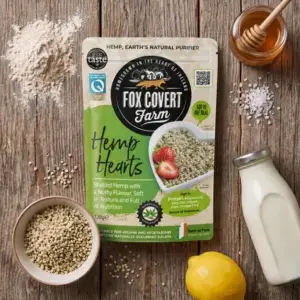
Hemp Hearts are shelled hemp seeds, the outer hull has been removed to leave the soft inner kernel. They have a mild, slightly nutty flavour and a texture somewhere between a sesame seed and a pine nut. Because they are soft, they integrate easily into food without dominating it. They work well on porridge, cereals, stirred into yoghurt, scattered over salads, or added to smoothies with no blending required.
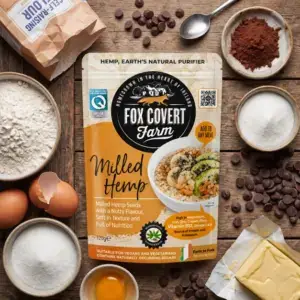
Milled Hemp is ground hemp seed, hull included. The texture is closer to a coarse flour or fine powder. Because the hull is retained, the fibre content is higher, and the flavour is slightly earthier. Milled hemp works well blended into smoothies, mixed into baking (brown bread, muffins, and scones all take it well), or stirred into soups and stews at the end of cooking.
Both are versatile, both are simple to use, and both have the same single-ingredient label. The practical difference is texture and application, hearts for sprinkling, milled for blending.
The most common barrier to actually using hemp seeds is not knowing where to start. The answer is: start small and start somewhere familiar.
If you eat porridge in the morning, scatter a tablespoon of hemp hearts over the top. They soften slightly in the heat and add a gentle nutty note. If you make smoothies, add a tablespoon of milled hemp to the blender alongside everything else. If you bake brown bread, and most households in Ireland still do, replace a few tablespoons of flour with milled hemp for a protein boost with almost no change in texture or flavour.
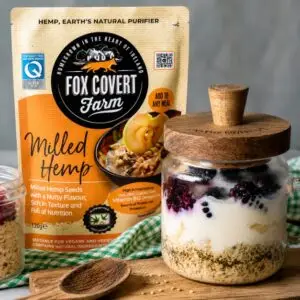
From there, the uses multiply. Hemp hearts work in salads the same way you’d use pumpkin seeds or sunflower seeds. Milled hemp adds a nutritional boost to soups, stews etc. Both can be added to homemade granola, energy balls, or overnight oats.
A useful starting point: if a recipe already uses any kind of seed or nut, try replacing it with, or supplementing it with, hemp hearts. The nutritional upgrade is significant and the adjustment in flavour is minimal.
Visit our Recipes page for specific instructions and ideas using both Hemp Hearts and Milled Hemp, everything from smoothies and brown bread to carrot muffins and hemp milk.
Fox Covert Farm hemp products are available to buy online through our shop, with delivery across Ireland. Orders over €50 qualify for free delivery. We also stock in a range of local retailers across the midlands, see our full Stockists list for locations.
If you are buying hemp seeds for the first time, the bundle options are a practical starting point, they let you try both Hemp Hearts and Milled Hemp at a lower per-unit cost and figure out which suits your kitchen better.
Everything we sell is grown, processed, and packed in Co. Offaly. There is no imported hemp in our products. What you buy from Fox Covert Farm was in the ground in Kilcormac the season before it reached your door.
Farm news, recipes and the odd offer from a family farm in Kilcormac, Co. Offaly. No daily spam, we’ve a farm to run.
Your 5% off code is on its way to your inbox now. If it doesn’t land in a minute or two, check the spam folder.
Great Taste 2024 · Irish Quality Food Awards